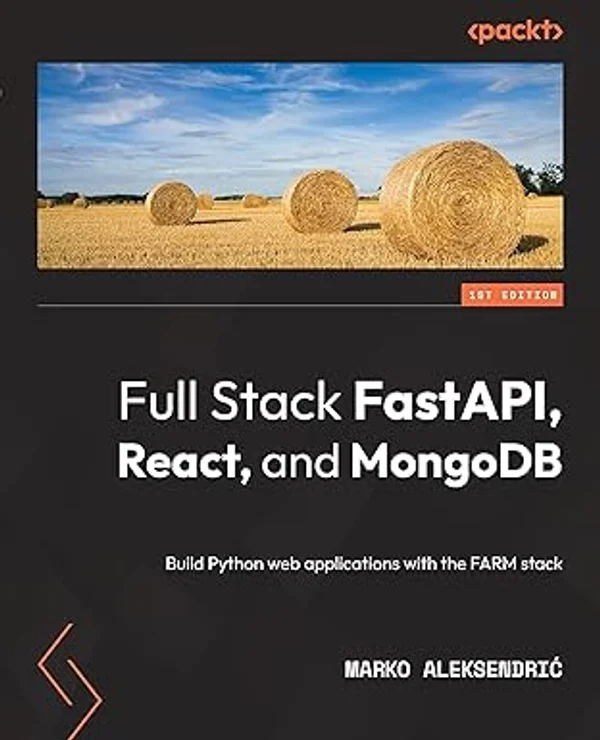
Full Stack FastAPI, React, and MongoDB: Build Python web applications with the FARM stack
A great stack: FastAPI + React.js + MongoDB!
BUY ON AMAZONBuilding Modern Web Applications with the FARM Stack: A Practical Guide
When I set out to write my first technical book, I had a very specific reader in mind: myself. As a developer who had spent years navigating the landscape of web development frameworks, I wanted to create the resource I wished had existed when I first discovered the powerful combination of FastAPI, React, and MongoDB—what has come to be known as the FARM stack.
Why the FARM Stack?
The web development ecosystem is crowded with acronyms: MERN, MEAN, PERN. Each represents a particular philosophy about how to build modern applications. The FARM stack distinguishes itself through one key element: FastAPI, a relatively young but remarkably mature Python-based asynchronous framework that has quickly become the darling of Python web developers.
For those of us who have lived in the Python ecosystem—using it for automation, data analysis, scientific computing—FastAPI represents a gateway to modern, high-performance web development without abandoning our favorite language. Combined with MongoDB's flexible document store and React's component-based UI paradigm, the stack offers a compelling alternative to the JavaScript-everywhere approach.
A Practical Approach to Learning
Full Stack FastAPI, React and MongoDB takes an unapologetically practical stance. This isn't a theoretical treatise or an exhaustive reference manual. Instead, it's a hands-on journey through building real applications, introducing concepts gradually as they become relevant.
The book begins with the fundamentals—setting up MongoDB, understanding FastAPI's elegant routing system, and grasping React's hook-based architecture. From there, it progresses to building complete applications: a full-fledged API with deployment, a React frontend with Tailwind CSS and React Router 6, JWT-based authentication systems, and eventually a data visualization application complete with Chart.js and email capabilities.
One chapter that I particularly enjoyed writing covers server-side rendering with Next.js. Here, readers encounter real-world challenges: file uploads, image processing, httpOnly cookie authentication, and deployment on Vercel. These are the problems that working developers face daily, and addressing them in a practical context makes the learning stick.
What's Inside
The book spans eleven chapters, each building on the previous:
The opening chapters establish the "why" of the FARM stack before diving into MongoDB's document model and FastAPI's async capabilities. React fundamentals follow, focusing on the hooks that matter most: useState and useEffect.
The middle section is where theory meets practice. Readers build a complete backend API, connect it to a React frontend, and implement JWT authentication. The coverage is sufficient to understand the concepts without drowning in edge cases.
Later chapters tackle more advanced territory: Next.js for server-side rendering, SWR for smarter data fetching, and Chart.js for visualization. The penultimate chapter covers deployment on Ubuntu with Nginx, Uvicorn, and Redis caching—the real-world infrastructure that production applications demand.
An Honest Acknowledgment
Every technical book is defined as much by what it excludes as what it includes. In the interest of transparency, I should mention what you won't find in these pages: SQL databases (MongoDB is our data store), Jinja2 templating (React handles our UI), Docker containerization, third-party auth systems like Auth0, or in-depth testing coverage.
These are all valuable topics, but including them would have diluted the book's focus. The goal was to create a concentrated, practical guide to this specific stack—not an encyclopedia of web development.
Who This Book Is For
I wrote this book for web developers and analysts who want to harness modern asynchronous Python for web development. It's for those who appreciate MongoDB's flexibility, React's power, and Python's elegance. A beginner-level understanding of Python, JavaScript, HTML, and CSS is assumed—this isn't a first programming book.
If you've been curious about FastAPI, want to understand how these technologies fit together, or simply need a practical project-based approach to learning a new stack, I hope this book serves you as well as I intended it to serve myself.
Versioning
Although the book tries to show solid, applicable development techniques and how it all fits together, the book uses an older version of Next.js (13) and most of the Python packages have been upgraded since. But... this is where the second edition of the book comes into play!
"Full Stack FastAPI, React and MongoDB: Building Python Web Applications with the FARM Stack" is published by Packt Publishing and available on Amazon and other major booksellers. The complete code repository is available on GitHub